

High borosilicate glass has become a favored material in the production of candy jars, thanks to its exceptional properties such as high heat resistance, chemical stability, and transparency. As a supplier of High Borosilicate Candy Jars, I often get asked about the origin of this remarkable glass. In this blog, I'll delve into the history, production process, and unique features of high borosilicate glass used in our candy jars.

A Brief History of High Borosilicate Glass
The story of high borosilicate glass dates back to the early 20th century. In 1893, a German chemist named Otto Schott, who was also the co - founder of the Schott Glass company, developed a new type of glass that contained a significant amount of boron trioxide. This innovation was a game - changer in the glass industry. The initial application of high borosilicate glass was mainly in laboratory equipment due to its excellent chemical resistance and thermal stability.
During World War I, the demand for heat - resistant glass increased significantly as it was used in military applications such as lanterns and periscopes. After the war, high borosilicate glass found its way into various consumer products. Its use in kitchenware, including candy jars, started to gain popularity because of its ability to withstand sudden temperature changes without cracking.
Raw Materials for High Borosilicate Glass
The production of high borosilicate glass begins with carefully selected raw materials. The primary components include silica sand (SiO₂), boron trioxide (B₂O₃), and small amounts of other oxides such as sodium oxide (Na₂O), aluminum oxide (Al₂O₃), and potassium oxide (K₂O).
Silica sand is the base material for all types of glass. It provides the glass with its basic structure and hardness. Boron trioxide is the key ingredient that gives high borosilicate glass its unique properties. It lowers the glass's coefficient of thermal expansion, making it more resistant to thermal shock. Other oxides are added in small quantities to adjust the melting point, viscosity, and other physical properties of the glass.
The Manufacturing Process
The manufacturing process of high borosilicate glass is complex and requires precise control. Here is a step - by - step overview:
Batch Preparation
The raw materials are first weighed and mixed in the correct proportions. This mixture, known as the batch, is then loaded into a furnace. The quality of the batch preparation is crucial as it affects the uniformity and properties of the final glass product.
Melting
The batch is melted in a high - temperature furnace, typically at temperatures between 1500°C and 1600°C. At these temperatures, the raw materials react with each other to form a homogeneous molten glass. The melting process can take several hours to ensure complete melting and the removal of any bubbles or impurities.
Forming
Once the glass is molten, it is ready to be formed into the desired shape. For candy jars, the most common forming methods are blowing and molding. In the blowing process, a blob of molten glass is gathered on the end of a blowpipe. The glassblower then blows air into the pipe to shape the glass into a jar. Molding, on the other hand, involves pouring the molten glass into a mold and allowing it to take the shape of the mold.
Annealing
After forming, the newly shaped glass jars are placed in an annealing oven. Annealing is a heat - treatment process that relieves internal stresses in the glass. The jars are slowly cooled from a high temperature to room temperature over a period of several hours. This process is essential to prevent the glass from cracking or breaking due to stress.
Finishing
The final step in the manufacturing process is finishing. This includes cutting, grinding, and polishing the edges of the jars to give them a smooth and professional look. The jars may also be decorated or labeled at this stage.
Why High Borosilicate Glass is Ideal for Candy Jars
High borosilicate glass offers several advantages that make it an excellent choice for candy jars:
Thermal Resistance
One of the most significant benefits of high borosilicate glass is its high thermal resistance. It can withstand rapid temperature changes without cracking or shattering. This means that you can fill a high borosilicate candy jar with hot candies or place it in the refrigerator without worrying about damage to the jar.
Chemical Stability
High borosilicate glass is highly resistant to chemical corrosion. It does not react with acidic or alkaline substances, which makes it suitable for storing all types of candies, including those with high sugar or acid content. This ensures that the flavor and quality of the candies are preserved.
Transparency
The transparency of high borosilicate glass allows you to easily see the contents of the candy jar. This is not only aesthetically pleasing but also practical as it makes it easy to identify the type of candies inside without having to open the jar.
Durability
High borosilicate glass is more durable than ordinary glass. It is less likely to scratch or break, which means that your candy jars will last longer. This makes it a cost - effective choice in the long run.
Our High Borosilicate Candy Jars
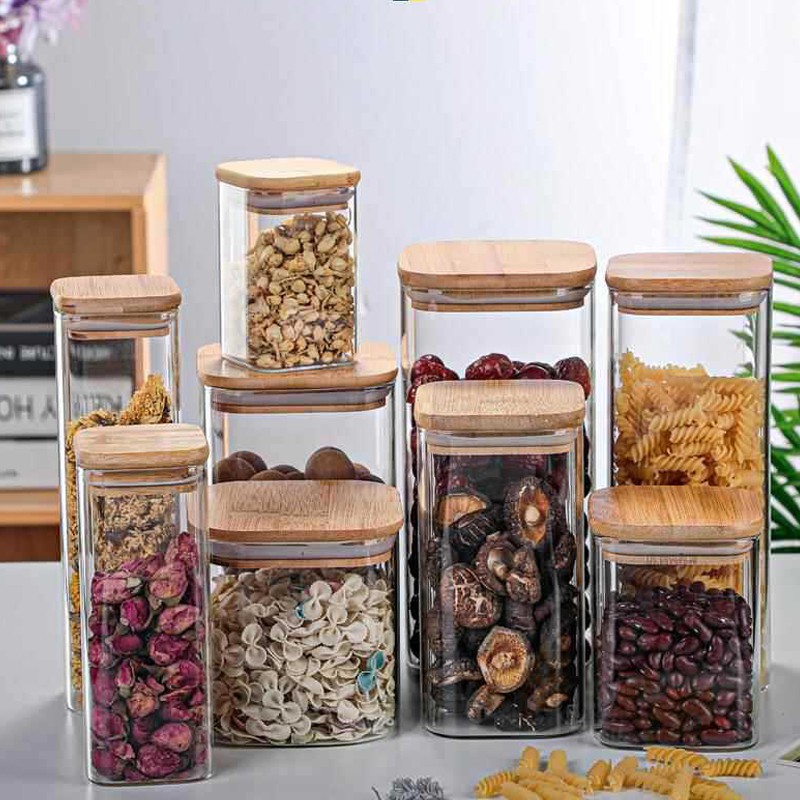
As a supplier of high borosilicate candy jars, we take pride in offering a wide range of products to meet the diverse needs of our customers. Our candy jars come in various shapes and sizes, including Square Airtight Storage Jars, which are perfect for keeping your candies fresh and protected. We also offer Acacia Wood Glass Storage Jars, which combine the beauty of wood with the functionality of high borosilicate glass. For larger storage needs, our Square High Borosilicate Storage Tank is an excellent option.
All of our high borosilicate candy jars are manufactured using the latest technology and strict quality control measures. We ensure that each jar meets the highest standards of quality and safety.
Contact Us for Procurement
If you are interested in purchasing high - quality high borosilicate candy jars for your business or personal use, we would love to hear from you. Our team of experts is ready to assist you with any questions you may have and to provide you with a competitive quote. Whether you need a small quantity for a special event or a large order for your store, we can accommodate your needs.
References
- Schott, O. (1893). On the constitution of glass. Journal of the American Ceramic Society.
- ASTM International. (2019). Standard Specification for Borosilicate Glass Tubing. ASTM E438 - 19.
- C. Halliday, R. Resnick, J. Walker. (2013). Fundamentals of Physics. Wiley.